
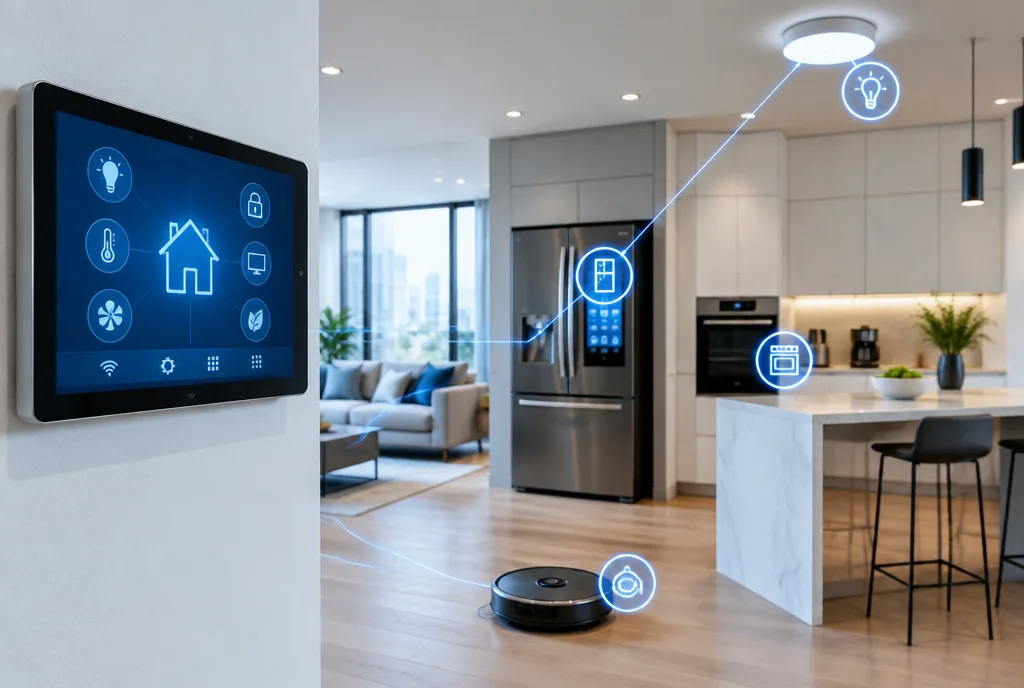
How many people have wished that they could have their house let the repairman in while they are at work, and then have dinner cooked and ready when they arrive home? Although these functions are not yet commonplace, they could be in the near future. Technology advancements have made our lives more simple and yet increasingly complex at the same time. Some people prefer to operate their homes the tried-and-true way, while others embrace technological advancements that can help centralize, streamline and optimize certain household functions. Homes with these new capabilities, most of which can be performed remotely, are called Smart Homes.
What is a Smart Home?
A Smart home is a residence that has many of its main functions, such as turning lights on and off, controlling the thermostat and opening the window blinds, controlled through an electronic system. This type of technology makes the home “smarter,” because one can operate these functions from a single control center inside the home. Some systems even allow people to operate various functions in their home while they are at work or driving in the car. Many people use this technology to save time and simplify their lives. Individuals can configure their home technology system so that they can control things like the music that plays through out the entire home with one button. People can even set the system so that a custom playlist starts playing upon entering their personal code into a keypad as they come into the house.
The Ultimate Control
One of the big advantages of having a Smart Home with a central control panel is the tight control homeowners can have over home security. Many homeowners have a video surveillance system installed, with a camera that lets them see the face of whoever happens to knock at the front door. Additionally, the home can be viewed from various camera vantage points from any computer, anywhere, 24 hours a day.
Cost Savings
One of the key benefits of Smart Home technology is the ability to tailor a home’s energy usage to peak and off-peak times. For example, instructing the lights to dim to 50 percent of their brightness at certain times of each day dramatically extends the life of light bulbs. The foyer lights can be scheduled to turn on only when the front door is opened. The window shades can be opened and closed at certain times to keep the home’s temperature stable and the thermostat can be set to automatically update its setting. These technologies could save a whopping 40 percent on electricity bills, according to the Energy Conservation Enhancement Project.
Smart Home technology is still in its infancy, yet it holds much promise. Smart technology is becoming more commonplace as homeowners try to embrace green living. Having control of the systems and energy usage in the house, and being able to cater to a family or individual’s own personal needs and preferences, may be a novelty now but more and more homeowners are beginning to embrace it because of the true advantages technology can offer.