
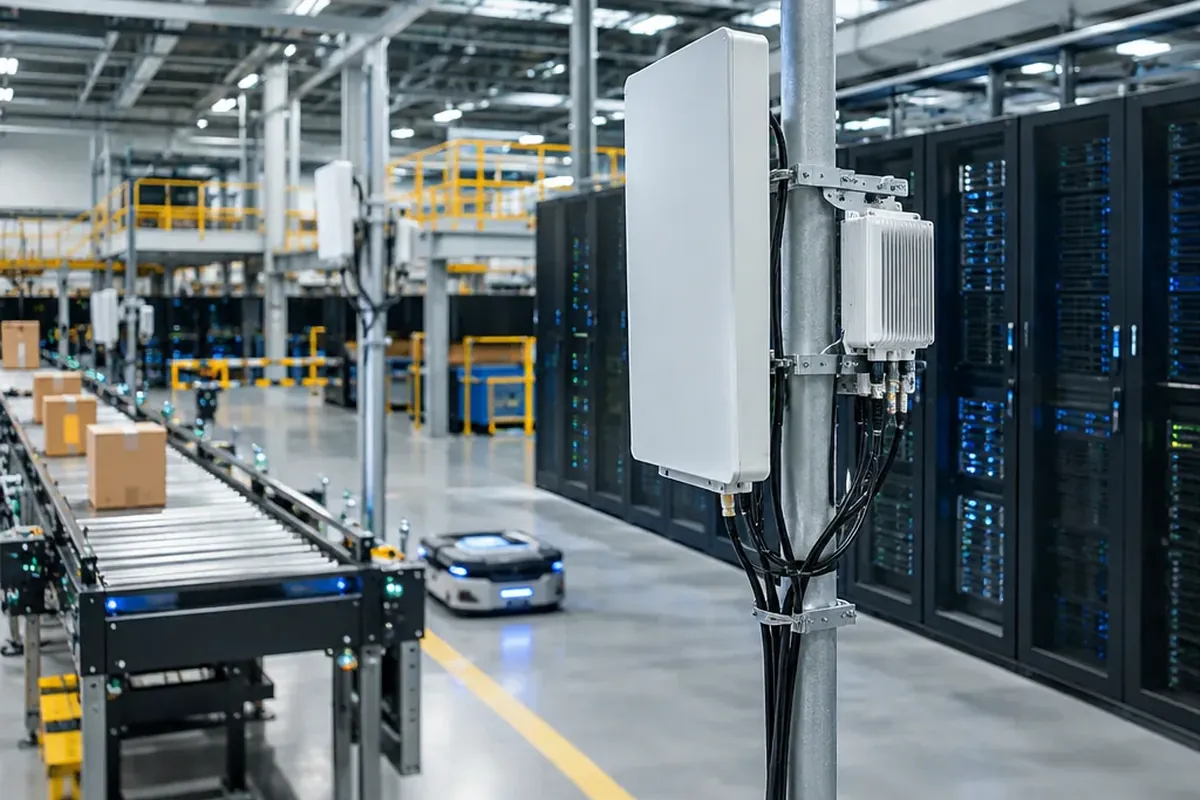
A private 5G network is a 3GPP-standard cellular network deployed exclusively for a single organization’s people, machines, and sites rather than the general public. It runs on the organization’s own core and controlled spectrum, so latency stays predictable and coverage reaches places where Wi-Fi struggles. Typical users are factories, ports, logistics sites, mines, campuses, and hospitals that connect robots, automated guided vehicles (AGVs), sensors, and medical devices.
What Is a Private 5G Network and How Does It Work?
The 3rd Generation Partnership Project (3GPP) calls private cellular networks Non-Public Networks (NPN) and first specified them formally in Release 16. The Global mobile Suppliers Association (GSA) defines a private mobile network as an LTE or 5G system built to 3GPP standards intended solely for private use, requiring at least a dedicated network core. In August 2025, GSA counted 1,846 private mobile network customers across 80 countries, up 7.7% from 1,714 a year earlier. Private 5G accounts for 28.5% of these customer deployments, LTE accounts for 51.1%, and mixed LTE/5G environments make up 19.0%.
Every private 5G network consists of three primary components:
- Connected Devices: Endpoints equipped with physical SIM cards or digital eSIM profiles, ranging from automated guided vehicles (AGVs) and industrial robots to handheld scanners and sensors.
- Radio Access Network (RAN): Base stations and small cells. Under 3GPP and O-RAN architecture, the RAN splits into three functional units: the Radio Unit (RU) handling radio frequency transmission and reception, the Distributed Unit (DU) managing real-time Layer 1 and Layer 2 baseband processing, and the Central Unit (CU) executing Radio Resource Control (RRC) and higher-layer processing.
- 5G Core Software: Housed in a network controller, the 5G core manages and routes data traffic between devices and external networks such as the internet or other private networks.
The 5G core comprises several key network functions: the Access and Mobility Management Function (AMF) handles endpoint access and mobility, the Session Management Function (SMF) manages user sessions, the User Plane Function (UPF) forwards payload traffic, the Unified Data Management (UDM) stores subscriber data, and the Authentication Server Function (AUSF) oversees authentication.
Deployments operate in either Non-Standalone (NSA) or Standalone (SA) mode. In NSA mode, 5G radios work alongside an LTE network and its 4G core. In Standalone (SA) mode, 5G radios connect directly to a dedicated 5G core. Only SA mode supports the full set of 5G Phase 1 services, including Ultra-Reliable Low-Latency Communication (URLLC).
US Spectrum Framework: How CBRS Powers Private 5G
In the United States, private cellular networks often use the Citizens Broadband Radio Service (CBRS) band, which spans 150 MHz from 3550 MHz to 3700 MHz. The Federal Communications Commission (FCC) adopted rules in 2015 establishing this band for shared commercial use under a three-tiered spectrum access framework:
- Tier 1: Incumbent Access: Protected federal users, primarily Department of Defense (DoD) radar and commercial Fixed Satellite Service (FSS) earth stations.
- Tier 2: Priority Access Licenses (PAL): Ten-megahertz channels within the 3550–3650 MHz portion of the band, licensed on a county-by-county basis via competitive bidding. FCC Auction 105 averaged approximately $222,000 per license, with a maximum of seven PALs per county.
- Tier 3: General Authorized Access (GAA): Licensed-by-rule access across the entire 150 MHz band wherever higher tiers are not using a channel. GAA requires no public auctions and no FCC license fees, allowing any eligible organization to operate.
Every CBRS radio must register with an FCC-approved Spectrum Access System (SAS) before transmitting. SAS administrators use a network of Environmental Sensing Capability (ESC) sensors to detect DoD radar and reassign commercial channels to prevent interference. By the end of 2023, more than 1,000 operators were using 370,000 active CBRS transmitters with zero reported incidents of harmful interference to federal operations. Recent changes to the aggregate interference model will expand unencumbered CBRS coverage to an additional 72 million people, reaching approximately 240 million nationwide.
Within this framework, CBRS radios operate on 3GPP Band n48 (3550–3700 MHz) for 5G New Radio (NR) and Band 48 for LTE. Hardware falls into two regulatory classifications: lower-power Category A radios for indoor or outdoor use, and higher-power Category B radios, which must be installed outdoors and professionally certified. Pre-packaged kits bundle radio units, SIM cards, and core software; each radio still needs a Certified Professional Installer (CPI) to register its geographic location. SAS providers charge for ongoing frequency coordination, with plans starting at about $500 per month for the first 200 radios. Providers can also exit: Google no longer takes new SAS customers and plans to shut down its SAS on June 10, 2027, so existing users must move to another SAS.
Private 5G vs. Wi-Fi 6 and Wi-Fi 7: Technical Comparison
Wi-Fi works well in offices, but industrial sites expose how differently the two technologies share the air. Wi-Fi runs in unlicensed spectrum and uses Carrier Sense Multiple Access with Collision Avoidance (CSMA/CA), where devices compete for airtime. In contrast, 5G NR uses centralized Orthogonal Frequency Division Multiple Access (OFDMA) scheduling, which delivers deterministic, bounded latency.
| Performance Metric | Private 5G (Standalone NR) | Wi-Fi 7 (802.11be) |
|---|---|---|
| Spectrum Model | Licensed or coordinated shared (CBRS) spectrum; protected from interference | Unlicensed spectrum; subject to interference from neighboring networks and consumer devices |
| Media Access Mechanism | Centrally scheduled OFDMA; deterministic transmission windows | CSMA/CA contention-based access |
| User Plane Latency | 1–4 ms one-way bounded latency via 3GPP URLLC | Sub-5 ms statistical (non-guaranteed) latency |
| Tail Latency Under Load | Bounded between 27.6 and 34.4 ms (Aalborg University study) | 128–264 ms under load and during mobility (Wi-Fi 6 baseline, Aalborg University study) |
| Client Handover Performance | Seamless make-before-break transition under 10 ms | Basic Service Set (BSS) transition takes 50–200 ms with brief interruption |
| Client Density per Node | 1,000+ devices per gNB with massive MTC support | 100–256 clients per Access Point in practice |
| Outdoor Coverage Footprint | 4 access points required per 1,000,000 sq ft outdoor space | 20 access points required per 1,000,000 sq ft outdoor space |
| Peak Theoretical Throughput | 1.5–2.0 Gbps per cell (100 MHz channel, 4×4 MIMO); even capacity distribution | Up to ~46 Gbps theoretical maximum (320 MHz, 16×16 MIMO, 4K-QAM) |
| Authentication Architecture | SIM/eSIM mutual authentication (5G-AKA or EAP-AKA’); PDCP ciphering and integrity protection | Add-on security solutions |
Enterprise Deployment Models: From Standalone NPN to Network Slicing
3GPP defines two NPN deployment types: Standalone Non-Public Networks (SNPN), which are fully isolated with dedicated RAN and core, and Public Network Integrated NPN (PNI-NPN), which share mobile network operator (MNO) infrastructure. The Canadian Centre for Cyber Security identifies four primary deployment models:
- Standalone Private Network (SNPN): The enterprise owns and operates the entire RAN and 5G core, manages subscriber authentication, and maintains complete physical isolation from public networks. This model provides the highest security but is the most resource-intensive to deploy and maintain.
- Shared Radio Access Network (Shared RAN): The organization uses the public mobile operator’s RAN infrastructure but retains control of core functions and user plane traffic. This model is suitable for large-scale deployments requiring seamless roaming.
- Shared RAN and Control Plane: The enterprise uses both the public mobile operator’s radio access network and its control plane.
- Network Slicing (Virtual PNI-NPN): The organization provisions an isolated virtual network partition on a public 5G network, allocating distinct performance profiles for different applications. It is the lowest-cost option and the fastest to launch. A study in Telecommunications Policy estimated that dedicated private industrial networks need an initial capital expenditure (CAPEX) of €1.27 million to €2.28 million, while network slicing cuts the initial investment by 33% to 68%.
Enterprise procurement options include self-integrated DIY hardware, supported network-in-a-box equipment, turnkey integrator projects, neutral host arrangements, and managed Network-as-a-Service (NaaS). Cloud-managed cores can run the full set of 5G network functions, including subscriber database, policy control, control plane, and user plane, on an edge computing platform at the site.
Who Uses Private 5G? Real-World Industry Deployments
Private cellular networks support Industry 4.0 applications including industrial robotics, automated guided vehicles (AGVs), smart electrical grids, autonomous haulage systems, and the Internet of Medical Things (IoMT). According to GSA records, manufacturing leads private mobile network deployments globally with 359 networks, followed by education and research (164 deployments) and mining (134 deployments). Deployments are concentrated in high- and upper/middle-income markets led by the United States, Germany, and the United Kingdom, where dedicated or shared spectrum is accessible. In Finland, neutral third-party system integrators such as Digita and Vaiscom facilitate private spectrum licensing and equipment sourcing without requiring enterprise infrastructure ownership.
Operational enterprise deployments include:
- Automotive and Manufacturing: Tesla deployed private 5G at its 12-million-square-foot Gigafactory Texas to eliminate AGV stoppages caused by unstable Wi-Fi, and at Gigafactory Berlin-Brandenburg resolved up to 90% of overcycle issues in general assembly. Jaguar Land Rover’s Solihull plant connected sensors in a five-story paint shop previously left unwired due to Ethernet cost and complexity, resolving Wi-Fi signal penetration issues in the metal-heavy environment. John Deere aims to reduce factory wired Ethernet dependency from 70% to 10% over five years by deploying private 5G across facilities in the US, South America, and Europe. Component manufacturer IKD replaced 6 miles of cables connecting 600 machines with private 5G, reducing cable maintenance costs to near zero and raising product yield by 10%. Delta Electronics reported 69% higher productivity per direct labor and 75% higher output per square meter after deploying 5G-connected smart production lines in Taiwan and Thailand. Steel producer Baosteel implemented private 5G across 43 sites, cutting manual inspections by 50%, achieving a steel defect detection rate above 90%, and saving $7 million annually by reducing lost production from 9,000 to 700 tons.
- Ports, Freight Terminals, and Aviation Logistics: Lufthansa Cargo at LAX cut item processing times by 60% after switching from Wi-Fi to private 5G, eliminating latency spikes and dropped connections that had forced paper-based workarounds. Port of Tyne in the UK utilizes private 5G for live container scanning, AI-enabled road monitoring, drones, and remote-controlled shovels. HavelPort Berlin integrated an Open RAN-compliant private 5G network for automated bulk goods weighing and drone-based inventory control, increasing annual weighing capacity by up to 60%. The EWG Intermodal Terminal increased container handling from 23–25 to 32–35 per hour and reduced personnel-related operating expenses by 40% using private 5G remote crane operations with under 20 ms latency. Cement producer CIMPOR deployed private 5G across three plants, connecting over 10,000 sensors for autonomous drone inspections and real-time remote support.
- Public Infrastructure and Defense Logistics: The City of Istres in France reduced video surveillance camera installation costs from $34,000 to under $6,000 per unit by replacing fiber with private 5G. U.S. Marine Corps Logistics Base Albany achieved 98% inventory accuracy, a 65% increase in goods velocity, and a 55% reduction in labor costs under a $6 million sustainment contract.
Security Architecture and Network Isolation
Private 5G uses the full 3GPP security framework. Devices connect with cryptographic keys stored on a SIM card or eSIM. Mutual authentication is enforced via 5G Authentication and Key Agreement (5G-AKA) or Extensible Authentication Protocol (EAP-AKA’). All devices must perform mutual authentication with the network’s Authentication Server Function (AUSF) before gaining access. To support private networks and industrial IoT devices lacking SIM cards, 3GPP Release 15 introduced the EAP framework, enabling certificate-based authentication such as EAP-TLS.
User traffic is protected with ciphering and integrity verification at the Packet Data Convergence Protocol (PDCP) layer, governed by a key hierarchy providing forward secrecy. The User Plane Function (UPF) ensures that only authenticated, authorized, and IP-addressed devices can transmit data through the network. Standalone private 5G provides complete physical isolation from public networks, making it the most secure deployment model and recommended for high-security applications and critical infrastructure.
However, private 5G networks face security vulnerabilities including radio frequency jamming, spoofing, weak access controls, insufficient role-based authentication, and supply-chain exposure. To mitigate these risks, the Canadian Centre for Cyber Security recommends several best practices:
- Develop dedicated incident response plans.
- Manage supply chain threats.
- Implement robust network and traffic monitoring.
- Retain the ability to disable outbound traffic to equipment vendors.
- Procure products exclusively from vendors with active software support contracts.
Implementation Costs, Hardware Economics, and Deployment Barriers
A private 5G budget covers radios, core software, installation, client devices, and ongoing operations:
- Radio and Software Packages: A small private 5G network with one indoor radio costs approximately $10,000, including first-year software. A distribution center requiring six professionally installed radios costs roughly $90,000 before devices. A large outdoor campus costs around $210,000.
- Installation and Electrical Works: Installation and electrical work typically account for 20% to 30% of the overall project budget. For a seaport, the same Telecommunications Policy study estimated €2.26 million in initial CAPEX and €3.71 million in OPEX over ten years for a dedicated private 5G network. Across deployments, annual infrastructure maintenance costs typically amount to 15% to 20% of the initial capital investment.
- Device Costs: Client devices frequently cost as much as the network itself; for example, deploying 20 ruggedized handheld scanners at approximately $2,000 each adds $40,000 to project costs.
The global private 5G market is forecast to grow from $4.8 billion in 2025 to $10.46 billion by 2030. However, adoption faces three primary barriers:
- High Capital Expenditure: The initial capital outlay for dedicated base stations, core software, and industrial user equipment.
- Integration Complexity: Technical hurdles when interfacing 5G cores with legacy operational technology (OT) and IT systems, including PLCs, SCADA platforms, and ERP software.
- Skills Shortage: A persistent industry talent gap across radio frequency (RF) engineering, 5G core administration, and OT integration.
Common Myths About Private 5G Networks
- Myth 1: Organizations must acquire expensive licensed spectrum through government auctions. In the United States, enterprises can deploy private 5G using the CBRS General Authorized Access (GAA) tier across 3550–3700 MHz. GAA is licensed-by-rule, requiring no FCC spectrum auctions and no licensing fees.
- Myth 2: Private 5G is designed to completely replace corporate Wi-Fi. Private 5G and Wi-Fi play complementary roles. Wi-Fi remains standard for offices and non-critical devices, while private 5G is deployed for deterministic latency, mobility, outdoor coverage, and mission-critical industrial applications.
- Myth 3: Private cellular networks are identical to public commercial carrier connections. A standalone private 5G network is physically isolated from public carrier networks. The organization runs its own radio network and core and controls which devices may connect.
Frequently Asked Questions
What is the difference between Standalone (SA) and Non-Standalone (NSA) private 5G?
In Standalone (SA) mode, 5G radios connect directly to a dedicated 5G core network. In Non-Standalone (NSA) mode, 5G radios operate alongside an LTE network and its 4G core. Only SA mode supports the full set of 5G Phase 1 services.
Do organizations need an FCC spectrum license to deploy private 5G in the United States?
No individual station license is required when using the General Authorized Access (GAA) tier of the Citizens Broadband Radio Service (CBRS) band (3550–3700 MHz). GAA is licensed-by-rule, allowing organizations to operate without FCC auctions or license fees, provided radios register with an FCC-approved Spectrum Access System (SAS).
How does private 5G handle device authentication without physical SIM cards?
Devices can use eSIMs or 3GPP’s Extensible Authentication Protocol (EAP) framework introduced in Release 15. This enables certificate-based authentication, such as EAP-TLS, for IoT devices and endpoints without SIM credentials.
Why do automated guided vehicles (AGVs) and mobile robots perform better on private 5G than on Wi-Fi?
Private 5G provides seamless make-before-break handovers in under 10 milliseconds and guaranteed bounded latency via scheduled OFDMA. In contrast, Wi-Fi handovers take 50 to 200 milliseconds with brief interruptions, and contention-based access can lead to latency spikes under load.
What are the primary ongoing operational expenses of a private 5G network?
Ongoing operational expenses include annual software and infrastructure maintenance (typically 15% to 20% of the initial investment) and monthly fees for SAS spectrum coordination in the CBRS band (plans start at about $500 per month for the first 200 radios).